Explainer: How are humanitarian conditions in Gaza after the ceasefire?

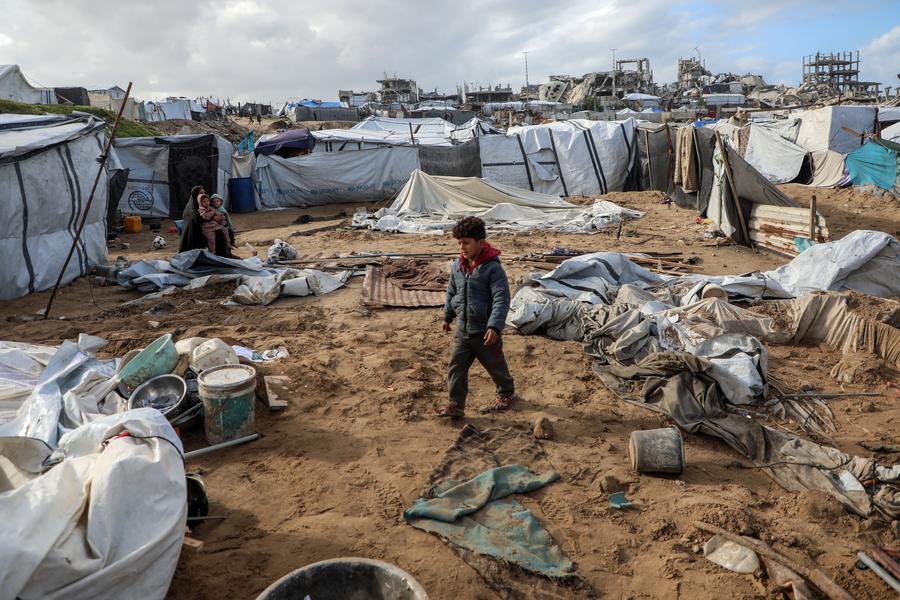
GAZA, Jan. 13 (Xinhua) -- Nearly three months after a Gaza ceasefire, humanitarian conditions in the besieged coastal enclave improved to some extent but remain dire, amid international calls for intensified efforts to deliver aid and ease suffering.
WINTER HARDSHIP
Despite the calm brought by the October ceasefire, conflict between Hamas and Israel has persisted, with one side accusing the other of violating the truce. Gaza-based health authorities have said that 424 people have been killed and 1,199 others injured in Gaza since the ceasefire.
"I don't believe there is a truce. This is a false truce," Abu Mohammed al-Qeedra, the father of a killed victim, told Xinhua at Nasser hospital in Khan Younis, where the bodies of the victims had been brought, and families gathered to mourn.
The winter weather isn't helping. Three people have died of cold by the end of December, including a two-month-old baby, according to Gaza-based health authorities.
"Since the start of winter, we have been flooded once, twice, three times. All the tarps were pulled outside. The bedding is soaked, and the clothes -- everything is flooded," Om Mohammed, a Palestinian woman in Gaza City, told Xinhua.
"People gave me a coat to wear to protect me from the cold," Mohammed said. "Everything around me is submerged in water. I am exhausted."
INSUFFICIENT AID
Following the ceasefire, larger volumes of supplies reached the Gaza Strip, easing food shortages to some extent.
In January, monthly food assistance has been adjusted to a ration of two food parcels and two 25-kilogram bags of flour per family, covering minimum caloric requirements, according to the United Nations Office for the Coordination of Humanitarian Affairs (OCHA).
That was the first time since October 2023 that UN partners have sufficient stock to meet minimum standards, the OCHA said.
In Gaza markets, food prices have fallen, supported by the gradual resumption of commercial imports. In the second week of December, some staple foods, such as wheat flour and sunflower oil, were even sold at below pre-war prices, according to the UN World Food Programme.
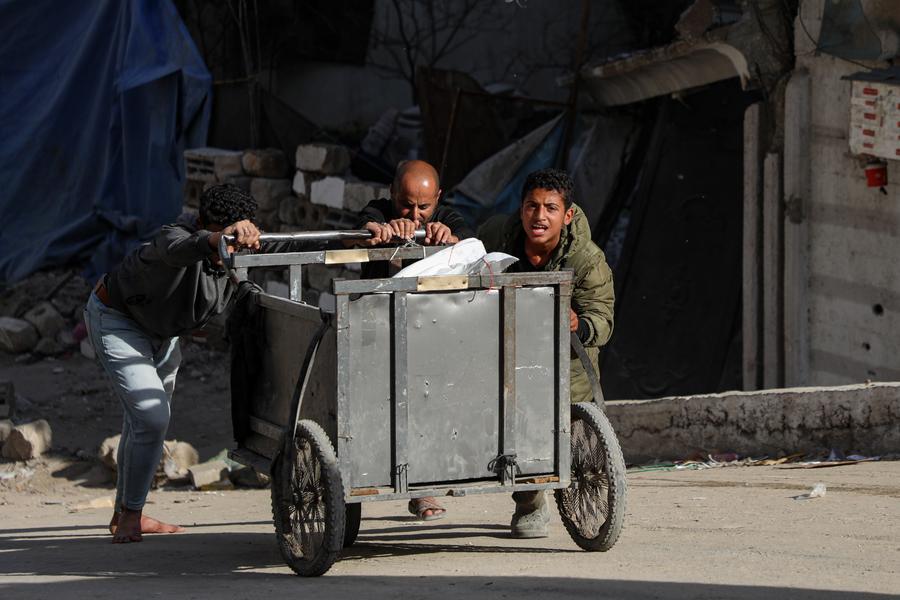
No areas of the Strip are currently classified as in famine, according to one analysis from multiple organizations and institutions. But UN organizations warned that this progress "remains extremely fragile" as Gazans continue to struggle with massive infrastructure destruction and collapsed livelihoods and food production.
"Gains are fragile -- perilously so," UN Secretary-General Antonio Guterres said in December. "And 1.6 million people in Gaza -- more than 75 percent of the population -- are projected to face extreme levels of acute food insecurity and critical malnutrition risks."
Aid deliveries remained insufficient and subject to restrictions. Between Oct. 10 and Dec. 16, some 9,000 tons of aid supplies were rejected by Israeli authorities for entry into Gaza, an OCHA report said.
"In the new year, we hope that ... prices will go back to what they were before the war, and that people will once again be able to buy their daily needs from malls in the usual way, like the rest of the world," Amir Salah, a vendor in Gaza City, told Xinhua.
AFTERMATH OF WAR
The conflict has left the Gazans with immense challenges, including unexploded ordnance. On Dec. 18, three incidents of explosive ordnance caused casualties in the Gaza Strip, according to the OCHA.
Intensive combat between Hamas fighters and Israeli forces and explosive devices deployed by both sides had left an "absolutely immense" level of contamination, said Julius Van Der Walt, chief of the UN Mine Action Programme in the Occupied Palestinian Territory.
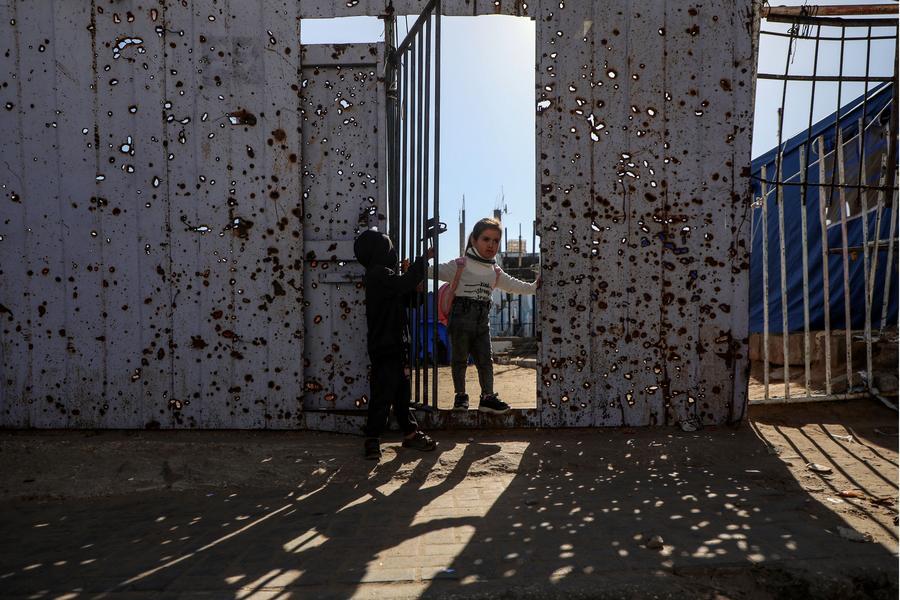
Mohammed al-Shafea, a Palestinian boy in Gaza City, told Xinhua that his family set up a tent in the city after being displaced to the south of the Strip.
His left leg was wrapped in bandages, and his back bore scars. Pointing to an area not far from the tent, he said, "We were playing there when it suddenly exploded, and we found ourselves thrown in every direction."
"We needed to cook something, so we started searching for wood and nylon to light a fire. We lifted something, and it exploded," he added.
His mother was worried about her kids because of the remnants of war. "We don't know what's beneath the rubble," she said.
Another challenge is solid waste management. Since October 2023, an estimated 66 million U.S. dollars in damages have been recorded in solid and medical waste management systems, according to an OCHA report.
Across the Gaza Strip, children were seen weaving through piles of garbage, with many playing atop the refuse. When it rained, sewage spilled out from the heaps. This could raise health risks and accelerate the spread of diseases, medical experts have warned.■












Comments