

欧美精品在线第一页,久久av影院,午夜视频在线播放一三,久久91精品久久久久久秒播,成人一区三区,久久综合狠狠综合久久狠狠色综合,成人av一区二区亚洲精,欧美a级在线观看
         Home Page | Photos | Video | Forum | Most Popular | Special Reports | Biz China Weekly
        Make Us Your Home Page
         
        Work Together to Build a Community of Shared Future for Mankind
                         | 2017-01-19 03:51:22 | Editor: yan

        SWITZERLAND-GENEVA-XI JINPING-UN-SPEECH

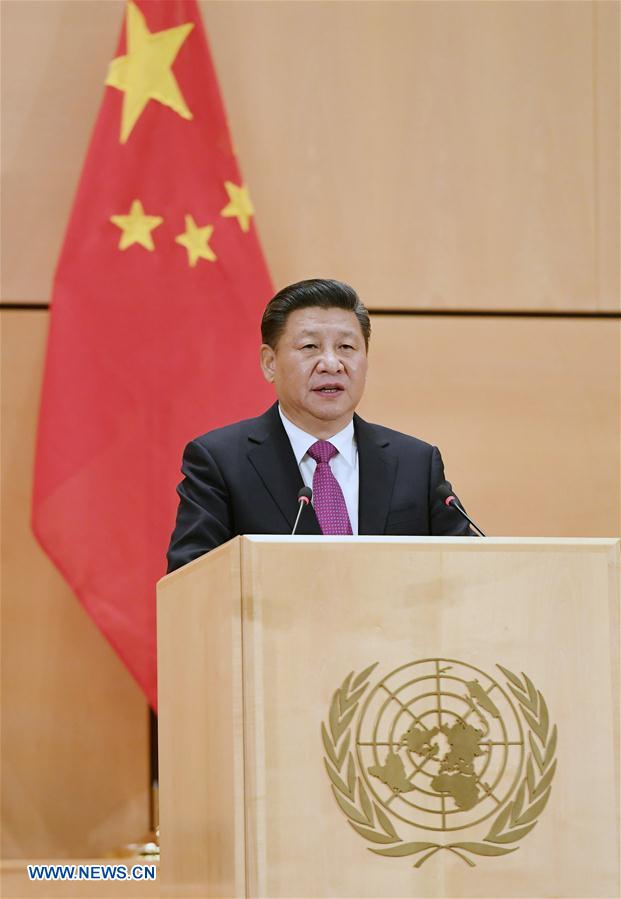
        Chinese President Xi Jinping delivers a keynote speech at the United Nations Office in Geneva, Switzerland, Jan. 18, 2017. (Xinhua/Rao Aimin)

        Work Together to Build a Community of Shared Future for Mankind

        Speech by H.E. Xi Jinping

        President of the People’s Republic of China

        At the United Nations Office at Geneva

        Geneva, 18 January 2017

        Your Excellency Mr. Peter Thomson, President of the 71st Session of the UN General Assembly,

        Your Excellency Mr. António Guterres, UN Secretary-General,

        Your Excellency Mr. Michael M?ller, Director-General of the UN Office at Geneva,

        Ladies and Gentlemen,

        Friends,

        As a new year begins, everything takes on a new look, and it gives me great pleasure to visit the United Nations Office at Geneva and discuss with you the building of a community of shared future for mankind, which is the call of our time.

        I just attended the World Economic Forum Annual Meeting. In Davos, many speakers pointed out in their speeches that today’s world is full of uncertainties and that people long for a bright future but are bewildered about what will come. What has happened to the world and how should we respond? The whole world is reflecting on this question, and it is also very much on my mind.

        I believe that to answer this question, we need to get clear about a fundamental issue: Where did we come from? Where are we now? And where are we going?

        Over the past century and more, mankind has gone through bloody hot wars and the chilling Cold War, but also achieved remarkable development and huge progress. In the first half of last century, mankind suffered the scourges of two world wars, and the people yearned for the end of war and the advent of peace. In the 1950s and 1960s, people in colonies awakened and fought to shake off shackles and achieve independence. Since the end of the Cold War, people have pursued a shared aspiration, namely, to expand cooperation and promote common development.

        Peace and development: this has been the aspiration held dear by mankind over the past century. However, the goal to achieve peace and development is far from being met. We need to respond to the people’s call, take up the baton of history and forge ahead on the marathon track toward peace and development.

        Mankind is in an era of major development as well as profound transformation and change. The trend toward multi-polarity and economic globalization is surging. IT application in social development and cultural diversity are making continued progress. A new round of scientific and industrial revolution is in the making. Interconnection and interdependence between countries are crucial for human survival. The forces for peace far outweigh factors causing war, and the trend of our times toward peace, development, cooperation and win-win outcomes has gained stronger momentum.

        On the other hand, mankind is also in an era of numerous challenges and increasing risks. Global growth is sluggish, the impact of the financial crisis lingers on and the development gap is widening. Armed conflicts occur from time to time, Cold War mentality and power politics still exist and non-conventional security threats, particularly terrorism, refugee crisis, major communicable diseases and climate change, are spreading.

        There is only one Earth in the universe and we mankind have only one homeland. Stephen Hawking has raised the proposition about “parallel universe”, hoping to find another place in the universe where mankind could live. We do not know when his wish will come true. Until today, Earth is still the only home to mankind, so to care for and cherish it is the only option for us mankind. There is a Latin motto inscribed in the dome of the Federal Palace of Switzerland which says “Unus pro omnibus, omnes pro uno” (One for all, and all for one). We should not only think about our own generation, but also take responsibility for future ones.

        Ladies and Gentlemen, Friends,

        Pass on the torch of peace from generation to generation, sustain development and make civilization flourish: this is what people of all countries long for; it is also the responsibility statesmen of our generation ought to shoulder. And China’s proposition is: build a community of shared future for mankind and achieve shared and win-win development.

        Vision guides action and direction determines the future. As modern history shows, to establish a fair and equitable international order is the goal mankind has always striven for. From the principles of equality and sovereignty established in the Peace of Westphalia over 360 years ago to international humanitarianism affirmed in the Geneva Convention 150-plus years ago; from the four purposes and seven principles enshrined in the UN Charter more than 70 years ago to the Five Principles of Peaceful Coexistence championed by the Bandung Conference over 60 years ago, many principles have emerged in the evolution of international relations and become widely accepted. These principles should guide us in building a community of shared future for mankind.

        Sovereign equality is the most important norm governing state-to-state relations over the past centuries and the cardinal principle observed by the United Nations and all other international organizations. The essence of sovereign equality is that the sovereignty and dignity of all countries, whether big or small, strong or weak, rich or poor, must be respected, their internal affairs allow no interference and they have the right to independently choose their social system and development path. In organizations such as the United Nations, World Trade Organization, World Health Organization, World Intellectual Property Organization, World Meteorological Organization, International Telecommunication Union, Universal Postal Union, International Organization for Migration and International Labor Organization, countries have an equal voice in decision-making, constituting an important force for improving global governance. In a new era, we should uphold sovereign equality and work for equality in right, opportunity and rules for all countries.

        Geneva witnessed the adoption of the Final Declaration on the Problem of Restoring Peace in Indo-China, the first summit meeting for reconciliation between the two blocs during the Cold War and the dialogue and negotiations on hotspot issues like the Iranian nuclear issue and the Syrian issue. What we can learn from both past and present is that dialogue and consultation is an effective way to bridge differences and political negotiation is the fundamental solution to end conflicts. When we have sincere wish, goodwill and political wisdom, no conflict is too big to settle and no ice is too thick to break.

        An ancient Chinese philosopher said, “Law is the very foundation of governance.” Here in Geneva, countries, on the basis of the UN Charter, concluded a number of international conventions and legal documents on political security, trade, development, social issues, human rights, science and technology, health, labor, intellectual property, culture and sports. The relevance of law lies in its enforcement. It is thus incumbent on all countries to uphold the authority of the international rule of law, exercise their rights in accordance with law and fulfill their obligations in good faith. The relevance of law also lies in fairness and justice. All countries and international judicial institutions should ensure equal and uniform application of international law and reject double standards and the practice of applying international law in a selective way, thus ensuring genuine equality and justice in the world.

        “The ocean is vast because it admits all rivers.” Openness and inclusiveness have made Geneva a center of multilateral diplomacy. We should advance democracy in international relations and reject dominance by just one or several countries. All countries should jointly shape the future of the world, write international rules, manage global affairs and ensure that development outcomes are shared by all.

        In 1862, in his book Un Souvenir de Solférino, Henry Dunant pondered the question of whether it is possible to set up humanitarian organizations and conclude humanitarian conventions. The answer came one year later with the founding of the International Committee of the Red Cross. Over the past 150-plus years, the Red Cross has become a symbol and a banner. In the face of frequent humanitarian crises, we should champion the spirit of humanity, compassion and dedication and give love and hope to the innocent people caught in dire situations. We should uphold the basic principles of neutrality, impartiality and independence, refrain from politicizing humanitarian issues and ensure non-militarization of humanitarian assistance.

        Ladies and Gentlemen, Friends,

        Great visions can be realized only through actions. Actions hold the key to building a community of shared future for mankind. To achieve this goal, the international community should promote partnership, security, growth, inter-civilization exchanges and the building of a sound ecosystem.

        — We should stay committed to building a world of lasting peace through dialogue and consultation. When countries enjoy peace, so will the world; when countries fight, the world suffers. From the Peloponnesian War in the fifth century BC to the two world wars and the Cold War that lasted more than four decades, we have drawn painful and profound lessons. “History, if not forgotten, can serve as a guide for the future.” By establishing the United Nations, those before us won more than 70 years of relative peace for the world. What we need to do is to improve the mechanisms and means to more effectively resolve disputes, reduce tension and put an end to wars and conflicts.

        The Swiss writer and Nobel laureate Hermann Hesse stressed the importance of serving “not war and destruction but peace and reconciliation”. Countries should foster partnerships based on dialogue, non-confrontation and non-alliance. Major powers should respect each other’s core interests and major concerns, keep their differences under control and build a new model of relations featuring non-conflict, non-confrontation, mutual respect and win-win cooperation. As long as we maintain communication and treat each other with sincerity, the “Thucydides trap” can be avoided. Big countries should treat smaller ones as equals instead of acting as a hegemon imposing their will on others. No country should open the Pandora’s box by willfully waging wars or undermining the international rule of law. Nuclear weapons, the Sword of Damocles that hangs over mankind, should be completely prohibited and thoroughly destroyed over time to make the world free of nuclear weapons. Guided by the principle of peace, sovereignty, inclusiveness and shared governance, we should turn the deep sea, the polar regions, the outer space and the Internet into new frontiers for cooperation rather than a wrestling ground for competition.

        — We should build a world of common security for all through joint efforts. No country in the world can enjoy absolute security. A country cannot have security while others are in turmoil, as threats facing other countries may haunt itself also. When neighbors are in trouble, instead of tightening his own fences, one should extend a helping hand to them. As a saying goes, “United we stand, divided we fall.” All countries should pursue common, comprehensive, cooperative and sustainable security.

        Terrorist attacks that have occurred in Europe, North Africa and the Middle East in recent years once again demonstrate that terrorism is the common enemy of mankind. Fighting terrorism is the shared responsibility of all countries. In fighting terror, we should not just treat the symptoms, but remove its root causes. We should enhance coordination and build a global united front against terrorism so as to create an umbrella of security for people around the world. The number of refugees has hit a record high since the end of the Second World War. While tackling the crisis, we should also get to its roots. Why would anyone want to be displaced if they have a home to return to? UNHCR and the International Organization for Migration should act as the coordinator to mobilize the whole world to respond effectively to the refugee crisis. China has decided to provide an additional 200 million yuan of humanitarian assistance for refugees and the displaced of Syria. As terrorism and refugee crises are closely linked to geopolitical conflicts, resolving conflicts provides the fundamental solution to such problems. Parties directly involved should return to the negotiating table, and other parties should work to facilitate talks for peace, and we should all respect the role the UN plays as the main channel for mediation. Pandemic diseases such as bird flu, Ebola and Zika have sounded the alarm for international health security. The WHO should play a leadership role in strengthening epidemic monitoring and sharing of information, practices and technologies. The international community should step up support and assistance for public health in African countries and other developing countries.

        — We should build a world of common prosperity through win-win cooperation. Development is the top priority for all countries. Instead of beggaring thy neighbor, countries should stick together like passengers in the same boat. All countries, the main economies in particular, should strengthen macro policy coordination, pursue both current and long-term interests and focus on resolving deep-seated problems. We should seize the historic opportunity presented by the new round of scientific and technological revolution and industrial transformation, shift growth models, drive growth through innovation and further unleash social productivity and social creativity. We should uphold WTO rules, support an open, transparent, inclusive and nondiscriminatory multilateral trading regime and build an open world economy. Trade protectionism and self-isolation will benefit no one.

        Economic globalization, a surging historical trend, has greatly facilitated trade, investment, flow of people and technological advances. Since the turn of the century, under the auspices of the UN and riding on the waves of economic globalization, the international community has set the Millennium Development Goals and the 2030 Agenda for Sustainable Development. Thanks to these initiatives, 1.1 billion people have been lifted out of poverty, 1.9 billion people now have access to safe drinking water, 3.5 billion people have gained access to the Internet, and the goal has been set to eradicate extreme poverty by 2030. All this demonstrates that economic globalization is moving in the right direction. Of course, challenges such as development disparity, governance dilemma, digital divide and equity deficit still exist. But they are growing pains. We should face these problems and tackle them, instead of taking no action, as we Chinese like to say, one should not stop eating for fear of getting choked.

        We should draw inspiration from history. Historians told us long ago that rapid economic development makes social reform necessary; but people tend to support the former while rejecting the latter. Instead of watching in hesitation, we should move forward against all odds. Answers can also be found in reality. The 2008 international financial crisis teaches us that we should strengthen coordination and improve governance so as to ensure sound growth of economic globalization and make it open, inclusive, balanced and beneficial to all. We should both make the cake bigger and share it fairly to ensure justice and equity.

        Last September, the G20 Summit in Hangzhou focused on global economic governance and other major issues, adopted the Blueprint on Innovative Growth, put development for the first time in global macro policy framework, and formulated an action plan.

        — We should build an open and inclusive world through exchanges and mutual learning. Delicious soup is made by combining different ingredients. Diversity of human civilizations not only defines our world, but also drives progress of mankind. There are more than 200 countries and regions, over 2,500 ethnic groups and multiple religions in our world. Different histories, national conditions, ethnic groups and customs give birth to different civilizations and make the world a colorful one. There is no such thing as a superior or inferior civilization, and civilizations are different only in identity and location. Diversity of civilizations should not be a source of global conflict; rather, it should be an engine driving the advance of human civilizations.

        Every civilization, with its own appeal and root, is a human treasure. Diverse civilizations should draw on each other to achieve common progress. We should make exchanges among civilizations a source of inspiration for advancing human society and a bond that keeps the world in peace.

        — We should make our world clean and beautiful by pursuing green and low-carbon development. Man coexists with nature, which means that any harm to nature will eventually come back to haunt man. We hardly notice natural resources such as air, water, soil and blue sky when we have them. But we won’t be able to survive without them. Industrialization has created material wealth never seen before, but it has also inflicted irreparable damage to the environment. We must not exhaust all the resources passed on to us by previous generations and leave nothing to our children or pursue development in a destructive way. Clear waters and green mountains are as good as mountains of gold and silver. We must maintain harmony between man and nature and pursue sustainable development.

        We should pursue green, low-carbon, circular and sustainable way of life and production, advance the 2030 Agenda for Sustainable Development in a balanced manner and explore a model of sound development that ensures growth, better lives and a good environment. The Paris Agreement is a milestone in the history of climate governance. We must ensure this endeavor is not derailed. All parties should work together to implement the Paris Agreement. China will continue to take steps to tackle climate change and fully honor its obligations.

        Swiss army knife embodies Swiss craftsmanship. When I first got one, I was amazed that it has so many functions. I cannot help thinking how wonderful it would be if an exquisite Swiss army knife could be made for our world. When there is a problem, we can use one of the tools on the knife to fix it. I believe that with unremitting efforts of the international community, such a knife can be made.

        Ladies and Gentlemen, Friends,

        For us Chinese, China will do well only when the world does well, and vice versa. Many people are quite interested in what policies China will pursue, and we have heard various views. Here, I wish to give you an explicit answer.

        First, China remains unchanged in its commitment to uphold world peace. Amity with neighbors, harmony without uniformity and peace are values cherished in the Chinese culture. The Art of War, a Chinese classic, begins with this observation, “The art of war is of vital importance to the State. It is a matter of life and death, a road to either survival or ruin. Hence it demands careful study.” What it means is that every effort should be made to prevent a war and great caution must be exercised when it comes to fighting a war. For several millennia, peace has been in the blood of us Chinese and a part of our DNA.

        Several centuries ago, China was strong and its GDP accounted for 30% of the global total. Even then, China was never engaged in aggression or expansion. In over 100 years after the 1840 Opium War, China suffered immensely from aggression, wars and chaos. Confucius said, “Do not do to others what you do not want others to do to you.” We Chinese firmly believe that peace and stability is the only way to development and prosperity.

        China has grown from a poor and weak country to the world’s second largest economy not by committing military expansion or colonial plunder, but through the hard work of its people and our efforts to uphold peace. China will never waver in its pursuit of peaceful development. No matter how strong its economy grows, China will never seek hegemony, expansion or sphere of influence. History has borne this out and will continue to do so.

        Second, China remains unchanged in its commitment to pursue common development. An old Chinese saying goes, when you reap fruits, you should remember the tree; when you drink water, you should remember its source. China’s development has been possible because of the world, and China has contributed to the world’s development. We will continue to pursue a win-win strategy of opening-up, share our development opportunities with other countries and welcome them aboard the fast train of China’s development.

        Between 1950 and 2016, China provided foreign countries with over 400 billion yuan of aid, and we will continue to increase assistance to others as its ability permits. Since the outbreak of the international financial crisis, China has contributed to over 30% of global growth each year on average. In the coming five years, China will import eight trillion US dollars of goods, attract 600 billion US dollars of foreign investment, make 750 billion US dollars of outbound investment, and Chinese tourists will make 700 million outbound visits. All this will bring more development opportunities to other countries.

        China pursues a path of development in keeping with its national conditions. We always put people’s rights and interests above everything else and have worked hard to advance and uphold human rights. China has met the basic living needs of its 1.3 billion-plus people and lifted over 700 million people out of poverty, which is a significant contribution to the global cause of human rights. The Belt and Road initiative I put forward aims to achieve win-win and shared development. Over 100 countries and international organizations have supported the initiative, and a large number of early harvest projects have been launched. China supports the successful operation of the Asian Infrastructure Investment Bank and other new multilateral financial institutions in order to provide more public goods to the international community.

        Third, China remains unchanged in its commitment to foster partnerships. China pursues an independent foreign policy of peace, and is ready to enhance friendship and cooperation with all other countries on the basis of the Five Principles of Peaceful Coexistence. China is the first country to make partnership-building a principle guiding state-to-state relations. It has formed partnerships of various forms with over 90 countries and regional organizations, and will build a circle of friends across the world.

        China will endeavor to put in place a framework of relations with major powers featuring general stability and balanced growth. We will strive to build a new model of major country relations with the United States, a comprehensive strategic partnership of coordination with Russia, partnership for peace, growth, reform and among different civilizations with Europe, and a partnership of unity and cooperation with BRICS countries. China will continue to uphold justice and friendship and pursue shared interests, and boost pragmatic cooperation with other developing countries to achieve common development. We will further enhance mutually beneficial cooperation with our neighbors under the principle of amity, sincerity, mutual benefit and inclusiveness. We will pursue common development with African countries in a spirit of sincerity, being result oriented, affinity and good faith. And we will elevate our comprehensive cooperative partnership with Latin America to a higher level.

        Fourth, China remains unchanged in its commitment to multilateralism. Multilateralism is an effective way to preserve peace and promote development. For decades, the United Nations and other international institutions have made a universally recognized contribution to maintaining global peace and sustaining development.

        China is a founding member of the United Nations and the first country to put its signature on the UN Charter. China will firmly uphold the international system with the UN as its core, the basic norms governing international relations embodied in the purposes and principles of the UN Charter, the authority and stature of the UN, and its core role in international affairs.

        The China-UN Peace and Development Fund has been officially inaugurated. We will make funds available to peace and development oriented programs proposed by the UN and its agencies in Geneva on a priority basis. China’s support for multilateralism will increase as the country continues to develop itself.

        Ladies and Gentlemen, Friends,

        Geneva invokes a special memory to us. In 1954, Premier Zhou Enlai led a Chinese delegation to the Geneva Conference, and worked with the Soviet Union, the United States, the United Kingdom and France to seek political settlement of the Korean issue and a ceasefire in Indo-China. This demonstrated China’s desire for peace and contributed Chinese wisdom to world peace. Since 1971 when China regained its lawful seat in the UN and began to return to international agencies in Geneva, China has gradually involved itself in disarmament, trade, development, human rights and social issues, putting forth Chinese proposals for the resolution of major issues and the making of important rules. In recent years, China has taken an active part in dialogues and negotiations on the Iranian nuclear issue, the Syrian issue and other hotspot issues, giving Chinese input to their political settlement. China applied to the International Olympic Committee to host both the summer and winter Olympic and Paralympic Games, and we have won the bids. In addition, we have gained endorsement from the International Union for Conservation of Nature for over a dozen applications for world natural heritage sites as well as world cultural and natural heritage sites. All this has presented Chinese splendor to the world.

        Ladies and Gentlemen, Friends,

        The ancient Chinese believed that “one should be good at finding the laws of things and solving problems”. Building a community of shared future is an exciting goal, and it requires efforts from generation after generation. China is ready to work with all the other UN member states as well as international organizations and agencies to advance the great cause of building a community of shared future for mankind.

        On 28 January, we Chinese will celebrate the Chinese New Year, the Year of the Rooster. The rooster symbolizes bright prospects and auspiciousness. As a Chinese saying goes, the crow of the golden rooster heralds a great day for all. With that, I wish you all the very best and a very happy Chinese New Year!

        Thank you.

        Related:

        Xi says China stays committed to upholding world peace

        GENEVA, Jan. 18 (Xinhua) -- Chinese President Xi Jinping said here Wednesday that China remains unchanged in its commitment to upholding world peace.

        He made the remarks while delivering an address at the UN Office at Geneva.

        "For several millennia, peace has been in the blood of us Chinese and a part of our DNA," said Xi.? Full story

        ?
        Interview: Xi's Davos speech "accurate about our times": Mexican expert
        ?
        Xi's remarks on globalization at Davos "very positive": UN official
        Back to Top Close
        Xinhuanet

        Work Together to Build a Community of Shared Future for Mankind

        2017-01-19 03:51:22

        SWITZERLAND-GENEVA-XI JINPING-UN-SPEECH

        Chinese President Xi Jinping delivers a keynote speech at the United Nations Office in Geneva, Switzerland, Jan. 18, 2017. (Xinhua/Rao Aimin)

        Work Together to Build a Community of Shared Future for Mankind

        Speech by H.E. Xi Jinping

        President of the People’s Republic of China

        At the United Nations Office at Geneva

        Geneva, 18 January 2017

        Your Excellency Mr. Peter Thomson, President of the 71st Session of the UN General Assembly,

        Your Excellency Mr. António Guterres, UN Secretary-General,

        Your Excellency Mr. Michael M?ller, Director-General of the UN Office at Geneva,

        Ladies and Gentlemen,

        Friends,

        As a new year begins, everything takes on a new look, and it gives me great pleasure to visit the United Nations Office at Geneva and discuss with you the building of a community of shared future for mankind, which is the call of our time.

        I just attended the World Economic Forum Annual Meeting. In Davos, many speakers pointed out in their speeches that today’s world is full of uncertainties and that people long for a bright future but are bewildered about what will come. What has happened to the world and how should we respond? The whole world is reflecting on this question, and it is also very much on my mind.

        I believe that to answer this question, we need to get clear about a fundamental issue: Where did we come from? Where are we now? And where are we going?

        Over the past century and more, mankind has gone through bloody hot wars and the chilling Cold War, but also achieved remarkable development and huge progress. In the first half of last century, mankind suffered the scourges of two world wars, and the people yearned for the end of war and the advent of peace. In the 1950s and 1960s, people in colonies awakened and fought to shake off shackles and achieve independence. Since the end of the Cold War, people have pursued a shared aspiration, namely, to expand cooperation and promote common development.

        Peace and development: this has been the aspiration held dear by mankind over the past century. However, the goal to achieve peace and development is far from being met. We need to respond to the people’s call, take up the baton of history and forge ahead on the marathon track toward peace and development.

        Mankind is in an era of major development as well as profound transformation and change. The trend toward multi-polarity and economic globalization is surging. IT application in social development and cultural diversity are making continued progress. A new round of scientific and industrial revolution is in the making. Interconnection and interdependence between countries are crucial for human survival. The forces for peace far outweigh factors causing war, and the trend of our times toward peace, development, cooperation and win-win outcomes has gained stronger momentum.

        On the other hand, mankind is also in an era of numerous challenges and increasing risks. Global growth is sluggish, the impact of the financial crisis lingers on and the development gap is widening. Armed conflicts occur from time to time, Cold War mentality and power politics still exist and non-conventional security threats, particularly terrorism, refugee crisis, major communicable diseases and climate change, are spreading.

        There is only one Earth in the universe and we mankind have only one homeland. Stephen Hawking has raised the proposition about “parallel universe”, hoping to find another place in the universe where mankind could live. We do not know when his wish will come true. Until today, Earth is still the only home to mankind, so to care for and cherish it is the only option for us mankind. There is a Latin motto inscribed in the dome of the Federal Palace of Switzerland which says “Unus pro omnibus, omnes pro uno” (One for all, and all for one). We should not only think about our own generation, but also take responsibility for future ones.

        Ladies and Gentlemen, Friends,

        Pass on the torch of peace from generation to generation, sustain development and make civilization flourish: this is what people of all countries long for; it is also the responsibility statesmen of our generation ought to shoulder. And China’s proposition is: build a community of shared future for mankind and achieve shared and win-win development.

        Vision guides action and direction determines the future. As modern history shows, to establish a fair and equitable international order is the goal mankind has always striven for. From the principles of equality and sovereignty established in the Peace of Westphalia over 360 years ago to international humanitarianism affirmed in the Geneva Convention 150-plus years ago; from the four purposes and seven principles enshrined in the UN Charter more than 70 years ago to the Five Principles of Peaceful Coexistence championed by the Bandung Conference over 60 years ago, many principles have emerged in the evolution of international relations and become widely accepted. These principles should guide us in building a community of shared future for mankind.

        Sovereign equality is the most important norm governing state-to-state relations over the past centuries and the cardinal principle observed by the United Nations and all other international organizations. The essence of sovereign equality is that the sovereignty and dignity of all countries, whether big or small, strong or weak, rich or poor, must be respected, their internal affairs allow no interference and they have the right to independently choose their social system and development path. In organizations such as the United Nations, World Trade Organization, World Health Organization, World Intellectual Property Organization, World Meteorological Organization, International Telecommunication Union, Universal Postal Union, International Organization for Migration and International Labor Organization, countries have an equal voice in decision-making, constituting an important force for improving global governance. In a new era, we should uphold sovereign equality and work for equality in right, opportunity and rules for all countries.

        Geneva witnessed the adoption of the Final Declaration on the Problem of Restoring Peace in Indo-China, the first summit meeting for reconciliation between the two blocs during the Cold War and the dialogue and negotiations on hotspot issues like the Iranian nuclear issue and the Syrian issue. What we can learn from both past and present is that dialogue and consultation is an effective way to bridge differences and political negotiation is the fundamental solution to end conflicts. When we have sincere wish, goodwill and political wisdom, no conflict is too big to settle and no ice is too thick to break.

        An ancient Chinese philosopher said, “Law is the very foundation of governance.” Here in Geneva, countries, on the basis of the UN Charter, concluded a number of international conventions and legal documents on political security, trade, development, social issues, human rights, science and technology, health, labor, intellectual property, culture and sports. The relevance of law lies in its enforcement. It is thus incumbent on all countries to uphold the authority of the international rule of law, exercise their rights in accordance with law and fulfill their obligations in good faith. The relevance of law also lies in fairness and justice. All countries and international judicial institutions should ensure equal and uniform application of international law and reject double standards and the practice of applying international law in a selective way, thus ensuring genuine equality and justice in the world.

        “The ocean is vast because it admits all rivers.” Openness and inclusiveness have made Geneva a center of multilateral diplomacy. We should advance democracy in international relations and reject dominance by just one or several countries. All countries should jointly shape the future of the world, write international rules, manage global affairs and ensure that development outcomes are shared by all.

        In 1862, in his book Un Souvenir de Solférino, Henry Dunant pondered the question of whether it is possible to set up humanitarian organizations and conclude humanitarian conventions. The answer came one year later with the founding of the International Committee of the Red Cross. Over the past 150-plus years, the Red Cross has become a symbol and a banner. In the face of frequent humanitarian crises, we should champion the spirit of humanity, compassion and dedication and give love and hope to the innocent people caught in dire situations. We should uphold the basic principles of neutrality, impartiality and independence, refrain from politicizing humanitarian issues and ensure non-militarization of humanitarian assistance.

        Ladies and Gentlemen, Friends,

        Great visions can be realized only through actions. Actions hold the key to building a community of shared future for mankind. To achieve this goal, the international community should promote partnership, security, growth, inter-civilization exchanges and the building of a sound ecosystem.

        — We should stay committed to building a world of lasting peace through dialogue and consultation. When countries enjoy peace, so will the world; when countries fight, the world suffers. From the Peloponnesian War in the fifth century BC to the two world wars and the Cold War that lasted more than four decades, we have drawn painful and profound lessons. “History, if not forgotten, can serve as a guide for the future.” By establishing the United Nations, those before us won more than 70 years of relative peace for the world. What we need to do is to improve the mechanisms and means to more effectively resolve disputes, reduce tension and put an end to wars and conflicts.

        The Swiss writer and Nobel laureate Hermann Hesse stressed the importance of serving “not war and destruction but peace and reconciliation”. Countries should foster partnerships based on dialogue, non-confrontation and non-alliance. Major powers should respect each other’s core interests and major concerns, keep their differences under control and build a new model of relations featuring non-conflict, non-confrontation, mutual respect and win-win cooperation. As long as we maintain communication and treat each other with sincerity, the “Thucydides trap” can be avoided. Big countries should treat smaller ones as equals instead of acting as a hegemon imposing their will on others. No country should open the Pandora’s box by willfully waging wars or undermining the international rule of law. Nuclear weapons, the Sword of Damocles that hangs over mankind, should be completely prohibited and thoroughly destroyed over time to make the world free of nuclear weapons. Guided by the principle of peace, sovereignty, inclusiveness and shared governance, we should turn the deep sea, the polar regions, the outer space and the Internet into new frontiers for cooperation rather than a wrestling ground for competition.

        — We should build a world of common security for all through joint efforts. No country in the world can enjoy absolute security. A country cannot have security while others are in turmoil, as threats facing other countries may haunt itself also. When neighbors are in trouble, instead of tightening his own fences, one should extend a helping hand to them. As a saying goes, “United we stand, divided we fall.” All countries should pursue common, comprehensive, cooperative and sustainable security.

        Terrorist attacks that have occurred in Europe, North Africa and the Middle East in recent years once again demonstrate that terrorism is the common enemy of mankind. Fighting terrorism is the shared responsibility of all countries. In fighting terror, we should not just treat the symptoms, but remove its root causes. We should enhance coordination and build a global united front against terrorism so as to create an umbrella of security for people around the world. The number of refugees has hit a record high since the end of the Second World War. While tackling the crisis, we should also get to its roots. Why would anyone want to be displaced if they have a home to return to? UNHCR and the International Organization for Migration should act as the coordinator to mobilize the whole world to respond effectively to the refugee crisis. China has decided to provide an additional 200 million yuan of humanitarian assistance for refugees and the displaced of Syria. As terrorism and refugee crises are closely linked to geopolitical conflicts, resolving conflicts provides the fundamental solution to such problems. Parties directly involved should return to the negotiating table, and other parties should work to facilitate talks for peace, and we should all respect the role the UN plays as the main channel for mediation. Pandemic diseases such as bird flu, Ebola and Zika have sounded the alarm for international health security. The WHO should play a leadership role in strengthening epidemic monitoring and sharing of information, practices and technologies. The international community should step up support and assistance for public health in African countries and other developing countries.

        — We should build a world of common prosperity through win-win cooperation. Development is the top priority for all countries. Instead of beggaring thy neighbor, countries should stick together like passengers in the same boat. All countries, the main economies in particular, should strengthen macro policy coordination, pursue both current and long-term interests and focus on resolving deep-seated problems. We should seize the historic opportunity presented by the new round of scientific and technological revolution and industrial transformation, shift growth models, drive growth through innovation and further unleash social productivity and social creativity. We should uphold WTO rules, support an open, transparent, inclusive and nondiscriminatory multilateral trading regime and build an open world economy. Trade protectionism and self-isolation will benefit no one.

        Economic globalization, a surging historical trend, has greatly facilitated trade, investment, flow of people and technological advances. Since the turn of the century, under the auspices of the UN and riding on the waves of economic globalization, the international community has set the Millennium Development Goals and the 2030 Agenda for Sustainable Development. Thanks to these initiatives, 1.1 billion people have been lifted out of poverty, 1.9 billion people now have access to safe drinking water, 3.5 billion people have gained access to the Internet, and the goal has been set to eradicate extreme poverty by 2030. All this demonstrates that economic globalization is moving in the right direction. Of course, challenges such as development disparity, governance dilemma, digital divide and equity deficit still exist. But they are growing pains. We should face these problems and tackle them, instead of taking no action, as we Chinese like to say, one should not stop eating for fear of getting choked.

        We should draw inspiration from history. Historians told us long ago that rapid economic development makes social reform necessary; but people tend to support the former while rejecting the latter. Instead of watching in hesitation, we should move forward against all odds. Answers can also be found in reality. The 2008 international financial crisis teaches us that we should strengthen coordination and improve governance so as to ensure sound growth of economic globalization and make it open, inclusive, balanced and beneficial to all. We should both make the cake bigger and share it fairly to ensure justice and equity.

        Last September, the G20 Summit in Hangzhou focused on global economic governance and other major issues, adopted the Blueprint on Innovative Growth, put development for the first time in global macro policy framework, and formulated an action plan.

        — We should build an open and inclusive world through exchanges and mutual learning. Delicious soup is made by combining different ingredients. Diversity of human civilizations not only defines our world, but also drives progress of mankind. There are more than 200 countries and regions, over 2,500 ethnic groups and multiple religions in our world. Different histories, national conditions, ethnic groups and customs give birth to different civilizations and make the world a colorful one. There is no such thing as a superior or inferior civilization, and civilizations are different only in identity and location. Diversity of civilizations should not be a source of global conflict; rather, it should be an engine driving the advance of human civilizations.

        Every civilization, with its own appeal and root, is a human treasure. Diverse civilizations should draw on each other to achieve common progress. We should make exchanges among civilizations a source of inspiration for advancing human society and a bond that keeps the world in peace.

        — We should make our world clean and beautiful by pursuing green and low-carbon development. Man coexists with nature, which means that any harm to nature will eventually come back to haunt man. We hardly notice natural resources such as air, water, soil and blue sky when we have them. But we won’t be able to survive without them. Industrialization has created material wealth never seen before, but it has also inflicted irreparable damage to the environment. We must not exhaust all the resources passed on to us by previous generations and leave nothing to our children or pursue development in a destructive way. Clear waters and green mountains are as good as mountains of gold and silver. We must maintain harmony between man and nature and pursue sustainable development.

        We should pursue green, low-carbon, circular and sustainable way of life and production, advance the 2030 Agenda for Sustainable Development in a balanced manner and explore a model of sound development that ensures growth, better lives and a good environment. The Paris Agreement is a milestone in the history of climate governance. We must ensure this endeavor is not derailed. All parties should work together to implement the Paris Agreement. China will continue to take steps to tackle climate change and fully honor its obligations.

        Swiss army knife embodies Swiss craftsmanship. When I first got one, I was amazed that it has so many functions. I cannot help thinking how wonderful it would be if an exquisite Swiss army knife could be made for our world. When there is a problem, we can use one of the tools on the knife to fix it. I believe that with unremitting efforts of the international community, such a knife can be made.

        Ladies and Gentlemen, Friends,

        For us Chinese, China will do well only when the world does well, and vice versa. Many people are quite interested in what policies China will pursue, and we have heard various views. Here, I wish to give you an explicit answer.

        First, China remains unchanged in its commitment to uphold world peace. Amity with neighbors, harmony without uniformity and peace are values cherished in the Chinese culture. The Art of War, a Chinese classic, begins with this observation, “The art of war is of vital importance to the State. It is a matter of life and death, a road to either survival or ruin. Hence it demands careful study.” What it means is that every effort should be made to prevent a war and great caution must be exercised when it comes to fighting a war. For several millennia, peace has been in the blood of us Chinese and a part of our DNA.

        Several centuries ago, China was strong and its GDP accounted for 30% of the global total. Even then, China was never engaged in aggression or expansion. In over 100 years after the 1840 Opium War, China suffered immensely from aggression, wars and chaos. Confucius said, “Do not do to others what you do not want others to do to you.” We Chinese firmly believe that peace and stability is the only way to development and prosperity.

        China has grown from a poor and weak country to the world’s second largest economy not by committing military expansion or colonial plunder, but through the hard work of its people and our efforts to uphold peace. China will never waver in its pursuit of peaceful development. No matter how strong its economy grows, China will never seek hegemony, expansion or sphere of influence. History has borne this out and will continue to do so.

        Second, China remains unchanged in its commitment to pursue common development. An old Chinese saying goes, when you reap fruits, you should remember the tree; when you drink water, you should remember its source. China’s development has been possible because of the world, and China has contributed to the world’s development. We will continue to pursue a win-win strategy of opening-up, share our development opportunities with other countries and welcome them aboard the fast train of China’s development.

        Between 1950 and 2016, China provided foreign countries with over 400 billion yuan of aid, and we will continue to increase assistance to others as its ability permits. Since the outbreak of the international financial crisis, China has contributed to over 30% of global growth each year on average. In the coming five years, China will import eight trillion US dollars of goods, attract 600 billion US dollars of foreign investment, make 750 billion US dollars of outbound investment, and Chinese tourists will make 700 million outbound visits. All this will bring more development opportunities to other countries.

        China pursues a path of development in keeping with its national conditions. We always put people’s rights and interests above everything else and have worked hard to advance and uphold human rights. China has met the basic living needs of its 1.3 billion-plus people and lifted over 700 million people out of poverty, which is a significant contribution to the global cause of human rights. The Belt and Road initiative I put forward aims to achieve win-win and shared development. Over 100 countries and international organizations have supported the initiative, and a large number of early harvest projects have been launched. China supports the successful operation of the Asian Infrastructure Investment Bank and other new multilateral financial institutions in order to provide more public goods to the international community.

        Third, China remains unchanged in its commitment to foster partnerships. China pursues an independent foreign policy of peace, and is ready to enhance friendship and cooperation with all other countries on the basis of the Five Principles of Peaceful Coexistence. China is the first country to make partnership-building a principle guiding state-to-state relations. It has formed partnerships of various forms with over 90 countries and regional organizations, and will build a circle of friends across the world.

        China will endeavor to put in place a framework of relations with major powers featuring general stability and balanced growth. We will strive to build a new model of major country relations with the United States, a comprehensive strategic partnership of coordination with Russia, partnership for peace, growth, reform and among different civilizations with Europe, and a partnership of unity and cooperation with BRICS countries. China will continue to uphold justice and friendship and pursue shared interests, and boost pragmatic cooperation with other developing countries to achieve common development. We will further enhance mutually beneficial cooperation with our neighbors under the principle of amity, sincerity, mutual benefit and inclusiveness. We will pursue common development with African countries in a spirit of sincerity, being result oriented, affinity and good faith. And we will elevate our comprehensive cooperative partnership with Latin America to a higher level.

        Fourth, China remains unchanged in its commitment to multilateralism. Multilateralism is an effective way to preserve peace and promote development. For decades, the United Nations and other international institutions have made a universally recognized contribution to maintaining global peace and sustaining development.

        China is a founding member of the United Nations and the first country to put its signature on the UN Charter. China will firmly uphold the international system with the UN as its core, the basic norms governing international relations embodied in the purposes and principles of the UN Charter, the authority and stature of the UN, and its core role in international affairs.

        The China-UN Peace and Development Fund has been officially inaugurated. We will make funds available to peace and development oriented programs proposed by the UN and its agencies in Geneva on a priority basis. China’s support for multilateralism will increase as the country continues to develop itself.

        Ladies and Gentlemen, Friends,

        Geneva invokes a special memory to us. In 1954, Premier Zhou Enlai led a Chinese delegation to the Geneva Conference, and worked with the Soviet Union, the United States, the United Kingdom and France to seek political settlement of the Korean issue and a ceasefire in Indo-China. This demonstrated China’s desire for peace and contributed Chinese wisdom to world peace. Since 1971 when China regained its lawful seat in the UN and began to return to international agencies in Geneva, China has gradually involved itself in disarmament, trade, development, human rights and social issues, putting forth Chinese proposals for the resolution of major issues and the making of important rules. In recent years, China has taken an active part in dialogues and negotiations on the Iranian nuclear issue, the Syrian issue and other hotspot issues, giving Chinese input to their political settlement. China applied to the International Olympic Committee to host both the summer and winter Olympic and Paralympic Games, and we have won the bids. In addition, we have gained endorsement from the International Union for Conservation of Nature for over a dozen applications for world natural heritage sites as well as world cultural and natural heritage sites. All this has presented Chinese splendor to the world.

        Ladies and Gentlemen, Friends,

        The ancient Chinese believed that “one should be good at finding the laws of things and solving problems”. Building a community of shared future is an exciting goal, and it requires efforts from generation after generation. China is ready to work with all the other UN member states as well as international organizations and agencies to advance the great cause of building a community of shared future for mankind.

        On 28 January, we Chinese will celebrate the Chinese New Year, the Year of the Rooster. The rooster symbolizes bright prospects and auspiciousness. As a Chinese saying goes, the crow of the golden rooster heralds a great day for all. With that, I wish you all the very best and a very happy Chinese New Year!

        Thank you.

        Related:

        Xi says China stays committed to upholding world peace

        GENEVA, Jan. 18 (Xinhua) -- Chinese President Xi Jinping said here Wednesday that China remains unchanged in its commitment to upholding world peace.

        He made the remarks while delivering an address at the UN Office at Geneva.

        "For several millennia, peace has been in the blood of us Chinese and a part of our DNA," said Xi.? Full story

        [Editor: yan ]
        010020070750000000000000011100001359947071
        主站蜘蛛池模板: 欧美日韩国产色综合一二三四| 国产综合久久精品| 国产原创一区二区 | 国产精品自拍不卡| 2023国产精品自产拍在线观看| 麻豆天堂网| 欧美日韩一区电影| 国产精品1区二区| 亚洲精品色婷婷| 正在播放国产一区二区| 自拍偷在线精品自拍偷无码专区| 日本午夜影视| 午夜私人影院在线观看| 色噜噜狠狠色综合中文字幕| 在线国产一区二区三区| 91丝袜国产在线播放| 欧美一区二区三区黄| 精品少妇一区二区三区| 午夜少妇性影院免费观看| 69久久夜色精品国产7777| 欧美日本三级少妇三级久久| 国产清纯白嫩初高生视频在线观看| 亚洲乱视频| 69久久夜色精品国产69乱青草| 狠狠色噜噜狠狠狠狠米奇7777| 国产午夜三级一区二区三| 亚洲一区二区国产精品| 国产欧美日韩综合精品一| 色一情一乱一乱一区免费网站| 91精品久久久久久久久久| 欧美一区二区三区高清视频| 精品国产一区二区三区忘忧草| 欧美三级午夜理伦三级老人| xxxx国产一二三区xxxx| 香港日本韩国三级少妇在线观看| 99久久国产综合精品色伊| 亚洲第一天堂无码专区| 一区二区欧美在线| 国产呻吟久久久久久久92| 日韩女女同一区二区三区| 日本二区在线观看| 精品99免费视频| 99久久国产综合| 销魂美女一区二区| 国产一区二区三区大片| 神马久久av| 一区二区三区四区国产| 国内精品在线免费| 欧美一区二区三区国产精品| 国产区精品区| 少妇又紧又色又爽又刺激视频网站| 欧美精品国产精品| 午夜欧美a级理论片915影院| 日韩无遮挡免费视频| 午夜a电影| 午夜天堂电影| 欧美激情视频一区二区三区免费 | 亚洲高清国产精品| 久久一级精品| 欧美三级午夜理伦三级中视频| 精品欧美一区二区精品久久小说| 国产乱色国产精品播放视频| 欧美一级特黄乱妇高清视频| 国产伦精品一区二区三区照片91| 国产精品尤物麻豆一区二区三区| 欧美在线观看视频一区二区三区| 日本一区二区免费电影| 日本高清一二三区| av狠狠干| 国产日韩一区二区三免费| 国产91一区| 国产精品伦一区二区三区级视频频| 91精品一区在线观看| 国产精品久久久久久久久久不蜜月 | 在线视频国产一区二区| 狠狠色狠狠色综合日日五| 午夜黄色网址| 国产精品乱码一区| 亚洲午夜精品一区二区三区| 91丝袜国产在线播放| 国产一区二区三区四区五区七| 日韩欧美激情| 亚洲欧美国产一区二区三区| 日本黄页在线观看| 久久精视频| 精品国产一区二区三区四区四| 国产玖玖爱精品视频| 欧美日韩国产精品一区二区| 国产精品久久国产三级国电话系列| 欧美精品在线视频观看| 国产女人好紧好爽| 亚洲一二三在线| 国产乱子伦农村xxxx| 99爱精品在线| 国产精品无码永久免费888| 97人人模人人爽人人喊38tv| 国产精品一区二区免费| 国产大学生呻吟对白精彩在线| 亚洲欧洲一区二区| 亚洲国产欧洲综合997久久,| 国产精品不卡在线| 久久久久久亚洲精品中文字幕| 精品久久久久久中文字幕大豆网| 国产亚洲综合一区二区| 国产精品美女一区二区视频| 国产乱人乱精一区二视频国产精品 | 国产1区2区3区| 李采潭伦理bd播放| 日韩亚洲国产精品| 中文字幕一区二区三区乱码视频| 亚洲欧美另类久久久精品2019| 国产精品久久久久激情影院| 97国产精品久久久| 美女被羞羞网站视频软件| 国产精品1234区| 又黄又爽又刺激久久久久亚洲精品| 日韩中文字幕一区二区在线视频| 欧美69精品久久久久久不卡| 日韩av中文字幕第一页| 性色av香蕉一区二区| 欧美久久一区二区三区| 欧美一区二区三区视频在线观看| 久久一区欧美| 91一区二区三区久久国产乱| 狠狠色噜噜狠狠狠合久| 国产精品免费专区| 99视频国产精品| 亚洲欧美国产精品va在线观看| 国产欧美三区| 国产午夜一级片| 精品国产乱码久久久久久久久| 国产亚洲精品久久yy50| 日本一区二区在线电影| 亚洲精品www久久久| 国产视频一区二区视频| 国产精品自产拍在线观看蜜| 国产在线一卡| 国产精品乱码一区二区三区四川人 | 国产白嫩美女在线观看| 亚州精品国产| 欧美乱大交xxxxx古装| 日韩精品一区二区中文字幕| 久久国产欧美视频| 韩国视频一区二区| 日韩国产不卡| 蜜臀久久99精品久久久| 欧美日韩中文不卡| 国产伦精品一区二区三区免费优势 | 久久亚洲精品国产一区最新章节| 久爱精品视频在线播放| 国产欧美一区二区三区免费视频| 色综合久久网| 欧美日韩三区二区| 日韩av三区| 日韩一区免费| 91丝袜诱惑| 色乱码一区二区三区网站| 7777久久久国产精品| 日本一区二区高清| 日韩亚洲欧美一区二区 | 日韩一区免费| 毛片大全免费看| 日韩精品久久一区二区三区| 国产91在线播放| 91avpro| 日韩一区二区中文字幕| 一区二区中文字幕在线| 久久久精品免费看| 欧美hdxxxx| 高清欧美精品xxxxx在线看| 国产精品九九九九九九| 国产丝袜一区二区三区免费视频 | 视频二区狠狠色视频| 久久精品一二三| 国产欧美精品一区二区三区小说| 一区二区三区国产视频| 激情久久一区二区| 国产精品欧美久久| 高清欧美精品xxxxx在线看| 国产伦精品一区二区三区免费优势| 欧美国产三区| 亚洲欧美日韩精品在线观看| 欧美日韩激情在线| 国产三级在线视频一区二区三区| 国产一区二区极品| 国产香蕉97碰碰久久人人| 97人人模人人爽视频一区二区 | 狠狠色丁香久久综合频道 | 国产精品自拍在线观看| 午夜影院h| 国产一级一区二区| 亚洲神马久久| 日本免费电影一区二区| 2023国产精品自产拍在线观看| 人人澡超碰碰97碰碰碰| 亚洲精品久久久久不卡激情文学| 日本一区午夜艳熟免费| 国产精品午夜一区二区三区视频| 欧美精品亚洲一区| 国产伦理精品一区二区三区观看体验 | 99久久国产免费| 午夜激情电影在线播放| 欧美日韩国产专区| 狠狠色噜狠狠狠狠| 福利电影一区二区三区| 日韩欧美精品一区二区| 色婷婷精品久久二区二区6| 国产二区不卡| 国产伦精品一区二区三区照片91| 国产精品伦一区二区三区级视频频 | 午夜亚洲影院| 91婷婷精品国产综合久久| 亚洲**毛茸茸| 国产品久精国精产拍| 强行挺进女警紧窄湿润| 亚洲福利视频一区二区| 国产一级自拍| 欧美一区二区三区日本| 日韩av在线中文| 在线观看v国产乱人精品一区二区| 欧美乱大交xxxxx| 国产精品国产三级国产播12软件| 午夜激情影院| 国产精品v一区二区三区| 国产人成看黄久久久久久久久| 99久久婷婷国产亚洲终合精品| 久久九九亚洲| 午夜黄色大片| 午夜理伦影院| 国产精品久久久久久亚洲美女高潮| 欧美激情精品一区| 97精品久久久午夜一区二区三区| 国产精品日韩精品欧美精品| 狠狠色丁香久久婷婷综合_中| 亚洲欧洲精品一区二区三区不卡| 国产精品天堂网| 国产精品高潮呻吟久| 91精品一区二区中文字幕| 狠狠色噜噜狠狠狠狠| 国产69精品99久久久久久宅男| 亚洲一区二区国产精品| 久久久久久亚洲精品中文字幕| 欧美一区免费| 国产视频一区二区在线播放| 亚洲国产精品入口| 99精品视频一区|